

Article
RecFest 2026: The AI Doom Loop in Pharmaceutical Recruitment
Posted on the 8th July 2026
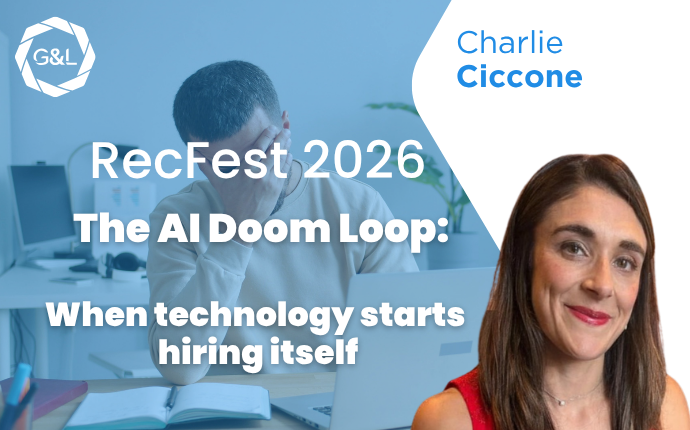

RecFest 2026 highlighted the transformative impact of artificial intelligence on talent acquisition.
In this article, Charlie Ciccone explores how this transformation is creating a new challenge for pharmaceutical recruitment: the emergence of the “AI Doom Loop.” As AI becomes embedded on both sides of the hiring process, there is a growing risk that efficiency comes at the expense of authenticity and insight.
Charlie offers a practical perspective on how organisations can balance technological advancement with the need to identify genuine expertise.
Artificial intelligence has transformed pharmaceutical recruitment. From screening thousands of CVs to identifying potential candidates in minutes, AI has become an essential tool for talent acquisition teams facing increasing hiring demands.
But beneath the efficiency lies a growing problem that many pharmaceutical organisations are only beginning to recognise: the AI Doom Loop.
The AI Doom Loop occurs when recruiters, candidates, and hiring technologies all optimise for each other’s algorithms instead of genuine human capability. The result is a recruitment process that becomes increasingly artificial, making it harder, not easier, to identify the best scientific and commercial talent.
The rise of AI on both sides of Rrcruitment
Today’s pharmaceutical candidates have unprecedented access to AI tools
Job seekers use AI to:
- Generate tailored CVs for every vacancy.
- Optimise applications for Applicant Tracking Systems (ATS).
- Produce polished cover letters in seconds.
- Prepare interview answers based on likely questions.
- Research company values and mirror desired behaviours.
At the same time, employers use AI to:
- Screen CVs.
- Rank candidates.
- Identify keyword matches.
- Automate candidate communications.
- Predict suitability based on historical hiring data.
In isolation, neither approach is inherently problematic.
The issue arises when both sides begin optimising for algorithms rather than people.
Why this matters in pharma
Unlike many industries, pharmaceutical hiring isn’t simply about finding someone who ticks technical boxes.
Whether recruiting a Qualified Person, Regulatory Affairs Manager, Clinical Project Lead, Medical Science Liaison, or Manufacturing Director, organisations need individuals who can navigate complexity, regulatory pressure, ethical decision-making, and cross-functional collaboration.
These qualities cannot always be measured through keyword density or AI-generated competency statements.
An AI-enhanced CV can make two candidates appear almost identical, even when their real-world capability differs significantly.
The danger is that exceptional professionals become indistinguishable from those who are simply better at using AI.
The homogenisation problem
Recruiters are increasingly seeing applications that follow remarkably similar structures and language.
Phrases such as:
- “Results-driven leader…”
- “Cross-functional stakeholder engagement…”
- “Strategic problem solver…”
- “Passionate about innovation…” appear repeatedly because AI models have learned what successful CVs look like.
Eventually, everyone sounds exceptional.
Ironically, nobody stands out.
This creates more work for hiring managers, not less.
The hidden cost of missing passive talent
Perhaps the biggest risk of the AI Doom Loop is what organisations never see.
The pharmaceutical industry has always relied heavily on passive candidates, experienced professionals who are succeeding in their current roles and aren’t actively applying for jobs.
These individuals often don’t spend time optimising CVs or gaming ATS systems.
Instead, they are identified through relationships, industry knowledge, referrals, and specialist recruiters.
If recruitment becomes overly dependent on AI-driven application processes, organisations risk overlooking exactly the people who could deliver the greatest long-term value.
Experience is more than keywords
Regulated industries value context.
A candidate may have:
- Led an MHRA inspection.
- Managed a product launch across multiple European markets.
- Supported FDA remediation.
- Built a Quality Management System from scratch.
- Managed technology transfer between manufacturing sites.
These experiences demonstrate judgment, resilience, and leadership.
Yet unless described using the “correct” keywords, AI screening tools may underestimate their relevance.
Conversely, AI-generated applications can perfectly describe experiences that candidates have only partially encountered.
This creates a growing challenge for hiring teams.
Interviews are changing too
Generative AI has also reshaped interview preparation.
Candidates can now receive model answers to virtually every behavioural question.
As a result, interviews increasingly feature polished, rehearsed responses that sound impressive but reveal little about genuine capability.
For pharmaceutical organisations making critical hires, particularly in Quality, Regulatory Affairs, Clinical Development, Pharmacovigilance, and Manufacturing, this presents a significant risk.
Hiring decisions require evidence of judgement, not simply eloquence.
Breaking the AI doom loop
The answer is not to reject AI.
AI remains an incredibly valuable tool for improving efficiency and reducing administrative burden.
Instead, organisations should rebalance technology with human expertise.
This might include:
- Using AI for administration, not decision-making.
- Allowing AI to support scheduling, note-taking, and initial data organisation while ensuring experienced recruiters make final judgements.
- Designing interviews around real experiences.
- Asking candidates to explain actual projects, regulatory challenges, or technical decisions rather than relying solely on competency questions.
- Looking beyond the CV.
- Industry reputation, referrals, networking, and specialist recruitment remain powerful indicators of quality, particularly in highly regulated sectors.
- Assessing thinking, not scripting.
- Scenario-based discussions often reveal far more than rehearsed answers. For example: “Tell me about a time an inspection didn’t go as planned. What happened, and what would you do differently today?”
These conversations are much harder to fabricate with AI.
The future of pharmaceutical recruitment
Artificial intelligence is here to stay, and it will continue to improve.
However, pharmaceutical organisations operate in an industry where product quality, patient safety, regulatory compliance, and scientific integrity depend on hiring exceptional people.
Technology should support better hiring, not replace human judgement.
The organisations that gain a competitive advantage will not be those using the most AI.
They will be those using AI wisely while continuing to invest in experienced recruiters, meaningful conversations, and robust assessment processes.
Because in pharmaceutical recruitment, the most valuable qualities, curiosity, integrity, resilience, critical thinking, and sound judgement, cannot be reduced to an algorithm.
As AI becomes more sophisticated, the real differentiator won’t be who has the smartest technology. It will be who remains best at recognising genuine human potential.
As a recruiter, I will embrace AI and am currently learning how to use it to make my workload more manageable.
But for me, nothing beats having a chat with a candidate, finding out more about you, and finding you your next role.
If you are a regulatory professional, please send me a DM or connect, and we can have a conversation.
Charlie Ciccone is Associate Director of Talent Management at G&L Scientific.