

Blog
Technology transfers in Pharmaceutical Manufacturing: A Regulatory perspective
Posted on the 23rd June 2026
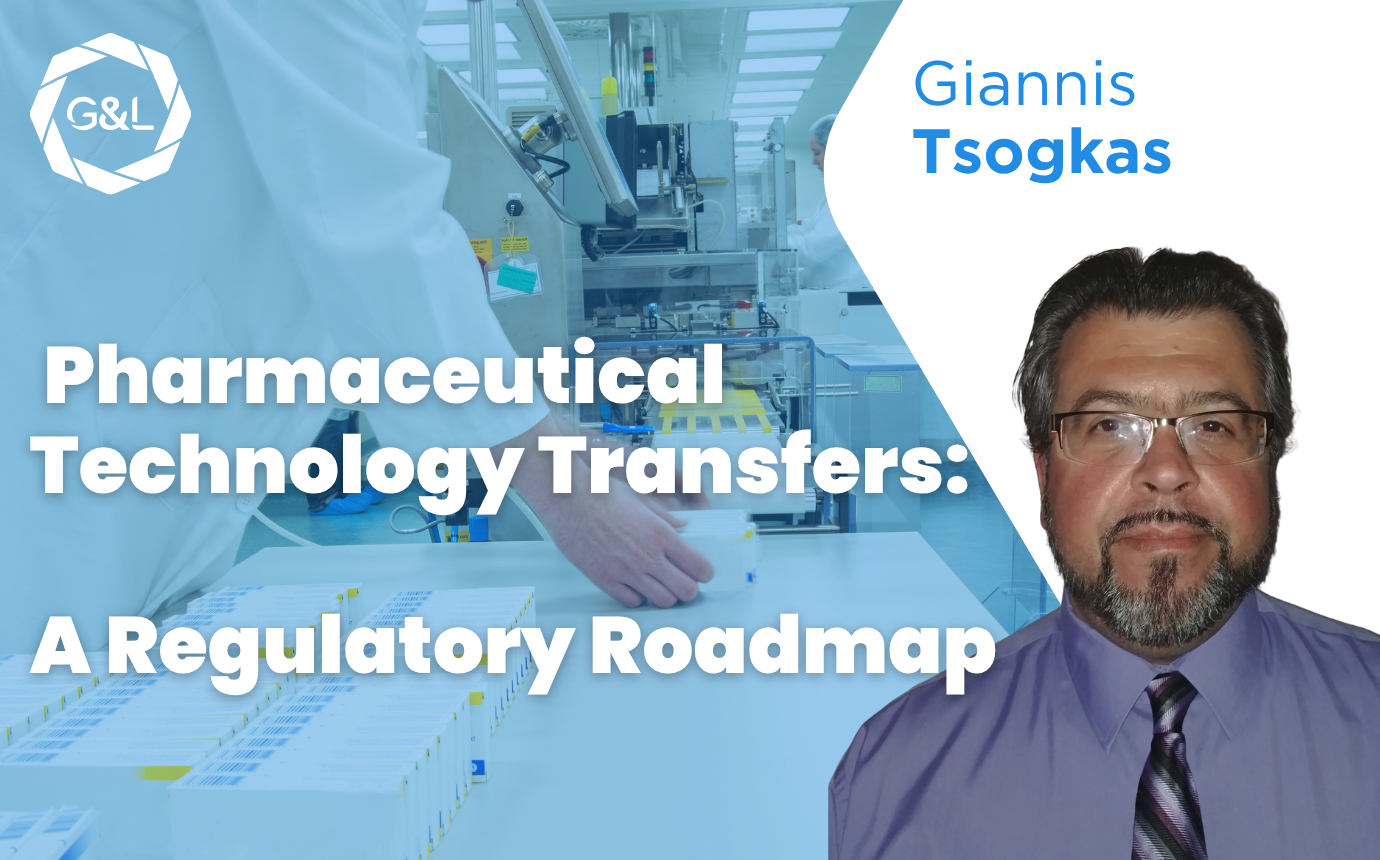

Giannis Tsogkas, Senior Manager of Regulatory Affairs at G&L Scientific, breaks down the key regulatory and operational considerations, submission strategies, and hidden risks that dictate the success of global technology transfers.
Technology transfers (or site transfers) refer to the transfer of some or all manufacturing operations from the currently registered manufacturing site (donor site) to a new manufacturing site (receiving site). They are among the most complex activities in the life cycle of a pharmaceutical product.
Detailed regulatory planning, cross-functional coordination, and a clear understanding of the requirements and risks across every market in which a product is registered are pivotal to ensuring its successful completion.
What Triggers a Technology Transfer?
Various reasons may trigger technology transfers, for example:
- Meeting increasing product demand. An additional manufacturing site can ensure that the product supply can continue as the demand for it increases. At the same time, an additional facility can mitigate any potential risks that may arise with the production of the drug product at the current facility, which can impact supply continuity.
- Freeing up capacity at the current site. Usually, the currently registered facility is the facility that developed the drug product and continued manufacturing for commercial supply. Transferring the production to a new facility will allow the donor site to focus its resources and capabilities on the development of new products.
- Current site is exiting the manufacturing operations of the product. Current site exiting the manufacture of the specific product for various strategic or operational decisions may lead a site to discontinue manufacturing of a specific product. In this case, there is usually a manufacturer's “cut-off” date planned at the current facility.
A technology transfer can therefore be considered as an alternative activity, where the receiving site is introduced as an addition, or as a replacement to the donor site in the regulatory dossiers. This distinction matters since certain markets allow only one manufacturing site to be registered, meaning a replacement scenario may be the only viable option regardless of the sponsor’s preference. The replacement of the donor by the receiving site can therefore be a bit more complicated, since the planning must include the preparation of the necessary product stock, to allow supply continuity up to the point that the receiving site is approved and can commence supply.
Building the Right Team
A successful technology transfer depends on assembling a multidisciplinary team capable of driving both the planning and execution of the project. Core functions typically include Quality/Analytical, Manufacturing Operations, Packaging Operations, Supply Chain, Labelling, and Regulatory.
From the outset, the team should establish clear roles and responsibilities, in particular, who is accountable for generating and providing the documentation needed to support regulatory submissions, and who will be involved in the review and approval process of CMC and other supporting documentation. Equally important is defining how the team will communicate and make decisions, ensuring that information flows efficiently across functions and that nothing falls through the gaps.
Beyond the core team, it is important to identify any functions that will require periodic input throughout the project, such as donor and receiving site experts or representatives from equivalent functions within these sites. Where the receiving site is an external Contract Manufacturing Organization (CMO), this stakeholder management engagement should be more carefully managed. Clear communication protocols and escalation pathways between the sponsor and CMO should be established early to avoid delays further down the line.
Defining the Changes: Donor Site vs. Receiving Site
Early in the planning phase, a thorough assessment of the differences in the manufacture of the drug product between the donor and receiving sites will need to be performed and documented. This goes beyond simply noting that a new site is involved; it requires a detailed, documented comparison of how the product will be manufactured at the receiving site relative to current practice at the donor site.
The use of different equipment may result in additional changes (i.e., batch size changes, different in-process controls, etc.). Any changes to excipient and packaging materials’ suppliers will need to be identified, and the potential impact on product quality should be assessed. The need to introduce new packaging configurations or expand existing ones to more markets will also need to be evaluated. Changes of this nature can significantly affect the regulatory pathway and submission complexity, so early identification is important.
All the proposed changes will need to be formally documented by the technical experts, and confirmation of their accuracy will need to be obtained from the donor and receiving sites before regulatory classification can commence. This confirmation step is critical. Proceeding based on incomplete or unverified information can lead to rework and delays that are difficult to recover from later in the project.
The Regulatory Expert's Role: Mapping the Landscape
With the technical changes defined, the Regulatory expert’s first task is to determine the currently registered details across all impacted markets and based on the identified changes, classify them according to relevant guidelines. When it comes to old/established products, where the lifecycle maintenance may not have been systematic, this may result in additional changes to be considered, to eliminate gaps between the registered details and the donor site’s current practice. These discrepancies will need to be addressed as part of the transfer exercise, adding scope that should be accounted for in the project plan from the outset. Identifying these gaps early is one of the most valuable contributions a regulatory expert can make at this stage.
At this stage, the Regulatory expert should provide the wider project team with a consolidated view covering:
- Documentation requirements – What needs to be generated to support the regulatory submissions across all impacted markets.
- Submission Strategy – The proposed approach for filing, including sequencing, grouping, and any market-specific considerations.
- Authoring, review, and approval timelines – For the time required to prepare, author, review, and approve CMC and other supporting documentation.
- Regulatory approval timelines – realistic estimates for variation approval across all impacted markets, accounting for differences in Health Authority (HA) review periods.
This briefing forms the foundation on which the rest of the project team can align their own workstreams and planning assumptions.
Developing a Submission Strategy
With the regulatory landscape mapped, the next step is to develop a submission strategy that is both comprehensive and realistic. Given the number of variables, this is rarely a simple exercise. The strategy must account for market-specific requirements, interdependencies between activities, and the practical constraints of supply continuity. At a minimum, the following elements should be considered:
- Wave-based submission sequencing. Splitting the submissions into waves. This is usually done considering specific market requirements, anticipated approval timelines, medical criticality of the product, and available submission pathways. The first wave would normally include major markets (like the EU, US, and Japan). These markets often act as Reference Countries for submissions in other countries (which may need to see an approval letter or a Certificate of Pharmaceutical Product (CPP) from a Reference Country). A second wave could include markets that do not require evidence of approval from Reference Countries. Subsequent waves should include all the markets where there is a dependency on a Reference Country (provision of an approval letter or a CPP). The number of submission waves should also consider the authoring capabilities of the team and the possibility of reusing existing documents. In addition, a waved submission approach will allow for better management of any deficiency letters that may be received. This will avoid stretching the team’s capacity and squeezing the response timelines.
- EU Supergrouping/Worksharing opportunities. Where the transfer involves multiple EU member states, the possibility of a Supergouping/Worksharing submission should be assessed. Eligibility will depend on the nature of the variations required, the degree of alignment between the currently registered dossiers, and the mix of procedure types involved; purely national and/or MR/DC and/or Centralized, each carry their own considerations.
- Parallel activities and their sequencing. Any other activities originating from the technology transfer activity, which need to occur before or in parallel to the regulatory submission. For example, certain markets may require a manufacturing site registration activity to waive a GMP inspection from the HA. This is considered a separate activity from the actual regulatory submission. The impact of such activities on the actual regulatory submission will have to be established to enable appropriate planning, and may impact the submission wave in which such markets need to be included (i.e. there may be markets where the site registration activity takes longer to be approved compared to the regulatory submission and the HA mandates that the regulatory submission can only be approved once the site registration activity is completed);
- Market-specific submission pathways. Any specific market regulations that may result in a different submission pathway. For example, registering a new packaging configuration in some markets can result in an upgrade of the submission from a variation to a new Marketing Authorization Application, which has a significant impact on approval timelines. On the other hand, some markets may have established fast-track submission pathways within their regulatory framework, which, if they can be applied, may lead to expedited approvals. These elements need to be factored in when the submission waves are determined.
- Competing lifecycle activities. Any other activities that may have an impact on the submission plan, i.e., upcoming or ongoing renewals or variations in markets where parallel submissions are not allowed. Again, these activities may influence the finalization of the submission waves.
- Sample requirements. Some HAs require physical samples from the receiving site to support the submission. The type of samples required and the stage at which they must be provided should be confirmed for each relevant market and built into the project timeline.
- Grace periods post-approval. HAs vary in how they treat products released from the donor site following approval of the transfer. Certain HAs will allow the supply of product released from the donor site within a given time frame after the approval of the technology transfer variation, while some HAs consider that no product from the donor site released after the approval date of the transfer can be placed on the market. This information is particularly important to the supply chain to ensure stock from the donor site is supplied to the markets appropriately. In addition, this information will need to be evaluated, taking into consideration the operational readiness timeline of the receiving site, following the approval of the variation.
- Residual shelf-life restrictions. Information on any restrictions certain markets may have in relation to residual product shelf life at the time of importation. This will allow us to establish any markets where the process validation batches, manufactured to support the variation, may not be able to be used, and additional production campaigns may need to occur.
- Shared pack coordination. For markets that share the same pack, the approval timelines need to be aligned as closely as possible. Submissions will need to be planned in a way that will allow for approval in markets sharing the same pack at a minimal time interval, minimizing any supply implications.
Risk Identification and Mitigation
Once the submission strategy is agreed upon, the team will also need to identify any potential risks and propose mitigation actions. Risks in a technology transfer can materialise at any stage, and span both technical and organisational dimensions:
- Execution delays. Delays in the execution of the transfer exercise, unexpected results, and delays in the provision of source documents. All have an impact on the regulatory submissions’ timelines. These are among the most common risks and should be monitored closely throughout the project.
- Submission – specific risks. Risks associated with the actual submissions, i.e., non-acceptance of the proposed grouping or no possibility of a Supergrouping/Worksharing due to differences in the registered details across EU markets. The latter may result in longer approval timelines (especially if the product is registered in EU markets through a purely national procedure), while the differences in the registered details will remain.
- Supply continuity risks. The gap between the donor site's manufacturing cut-off date and the regulatory approval of the receiving site is an inherently vulnerable period. Any delay in the submission or approval timeline directly extends this window, increasing the risk of stock shortages in one or more markets.
- Resource and capacity risks. People's availability, site downtime, and competing organisational priorities can all affect the pace of the project.
- Interdependencies with other lifecycle activities. Risks related to delays in other lifecycle activities managed by different teams, i.e., variations impacting the same CTD sections, renewals, and changes impacting labelling. These interdependencies are not always visible at the outset and require active monitoring.
Any delays in the submissions arising from the execution of the transfer exercise may be able to be partially mitigated by reducing the amount of time needed by the regulatory/publishing team to prepare the dossiers and make the submissions. The team may consider the submission of variations before the technology transfer to allow for the EU dossiers to be aligned and thus enabling the use of a Supergrouping/Worksharing submission for the transfer variation.
This may mitigate the risk of long approval timelines for the site transfer variation. Shelf-life extension variations may also be considered for submission beforehand, to mitigate issues relating to supply continuity. It is important to acknowledge, however, that not all risks can be mitigated.
A stock-out caused by unexpected demand surges, for instance, may fall outside the team's control regardless of how carefully the supply plan has been constructed. Transparent communication of residual risks to senior stakeholders is therefore as important as the mitigation planning itself.
Additional Considerations for Biologics and Biosimilars
While the principles outlined above apply broadly across drug product types, technology transfers involving biologics, including monoclonal antibodies, recombinant proteins, and other complex molecules, and biosimilars carry a distinct set of additional regulatory and technical challenges that warrant separate consideration.
Unlike small molecules, biologics are highly sensitive to changes in manufacturing process conditions. Even if the transfer involves no changes in the manufacturing process or in-process controls, minor differences between donor and receiving sites in equipment design or environmental controls can affect the product's quality attributes, including its safety and efficacy profile. As a result, regulatory authorities require a more extensive comparability exercise to demonstrate that the biological product manufactured at the receiving site is comparable to that from the donor site. This comparability data package, which may include analytical, functional, and in some cases clinical data, will need to be carefully scoped and planned early in the project or even discussed with the Regulatory Authority.
For biosimilars specifically, any manufacturing change post-approval introduces the additional complexity of maintaining the demonstrated similarity to the reference medicinal product. Regulatory agencies such as the EMA and FDA have issued specific guidance on managing post-approval manufacturing changes for biosimilars, and the evidentiary bar for demonstrating continued biosimilarity following a site transfer can be considerable.
Finally, it is worth mentioning that the introduction of a new manufacturing site for biotechnology products will require additional information to be provided for certain parts of the dossier, which is usually not considered for products based on chemical entities (i.e., information relating to the Facilities and Equipment). This may have an impact on the submission preparation timelines and will need to be carefully considered, especially for markets where the information required is quite extensive.
Conclusion
Technology transfers are complex life-cycle activities, and the regulatory scope alone can span multiple markets, multiple submission pathways, and years of planning and execution. Success depends on assembling the right cross-functional team early, establishing a clear and realistic submission strategy, and maintaining the flexibility to adapt as challenges arise.
For organisations managing these projects without dedicated in-house regulatory expertise or those facing particularly complex scenarios such as multi-market portfolios, biologics transfers, or tight supply continuity requirements, specialist support can make a significant difference to both timelines and outcomes.
G&L Scientific has extensive experience supporting technology transfer projects across a wide range of products, markets, and regulatory frameworks. If you are planning a site transfer and would like to discuss your specific situation, we would be happy to help.